Saturday, March 8, 2014

While we were in Prague, we visited St. Vitus, a church founded by Duke Wenceslaus, later St. Wencelaus, in the 10th century. Wencelaus was the grandson of the Bohemian saint and martyr Ludmila and continued his grandmother's work in converting the Slavic tribes within Bohemia. Although he was murdered in 935 by his brother and successor, the conversion of the Slavs did not stop. Once Bohemia was converted, later generations of Bohemian dukes and kings built larger churches on the site to accommodate larger congregations. 


In the 14th century, St. Vitus became the seat of the archbishop of Prague which prompted Charles IV of Bohemia to rebuild the church as a Gothic cathedral. The new cathedral was expected to be a coronation church, a royal crypt, a treasury building, and the resting place of St. Wencelaus; however, the cathedral was not completed until the 20th century. Over its history, it has fulfilled its expectations, but not quite as Charles IV envisioned.  


The chapel where the relics of St. Wencelaus rest.

The interior of the cathedral is not unlike other cathedrals; however, I felt as if though this cathedral is larger than other cathedrals I have visited.


While I loved the entire building, there were two aspects of the cathedral that took my breath away. The first was a structure that I assumed was the tomb of a Bohemian king. 


Built in the Baroque style, the structure is spectacular and I was awed by the grandeur of it. Until I saw it, the tomb of François I  was one of my favorite tombs, but  now it  has been displaced by the above structure (although, I still love the structures that the French kings built for themselves).  


The tomb of François I at St. Denis. 

As I mentioned, I assumed that the structure was the tomb of a Bohemian ruler. There was nothing to indicate who it was for, so that seemed to be a likely candidate. 

However, the tomb actually belongs to John of Nepomuk, a Bohemian saint and martyr. There are contrasting stories as to how he became a saint, but the most likely story, and the one recorded by contemporaries, is that he ran afoul of King Wencelaus IV, not to be confused with St. Wencelaus, over a political issue. In 1393, there was a need to appoint a new abbot for the abbey of Kladruby, an influential and rich abbey that Wencelaus wished to control as he fought with his nobles. Wencelaus had a candidate in mind for the position since secular rulers often appointed their own men to influential positions within the Church.  

However, John of Nepomuk, the vicar-general of the archbishop of Prague, confirmed as abbot a candidate that the abbey and the archbishop backed. This candidate was not amenable to Wencelaus and he ordered the torture and death of John of Nepomuk in response. Thus, on March 20, 1393, John of Nepomuk was thrown into the Vltava River after having been tortured. 


His death sparked a rebellion amongst Wencelaus's nobles, many of whom already opposed him. This rebellion led to his imprisonment at the hands of his nobles. Wencelaus was released upon a truce  and the remainder of his reign saw a build-up of religious tensions, which would result in the Hussite Wars.    

Unfortunately, I was unable to discover why John of Nepomuk has a tomb/shrine in the cathedral that was built in the Baroque era. However, the fact that he was a saint of Bohemia, and is still a saint of the Czech Republic, could explain why this shrine was erected within St. Vitus.

The other aspect of St. Vitus that made a lasting impression on me was the Golden Gate. 


The tower was completed during the Baroque period, but the mosaic, shown below, dates from the 14th century and represents the Last Judgement. 


To me, the mosaic is beautiful.  I feel it is a unique combination of Western art and Byzantine art which, if true, makes sense given the Czech Republic's location within Europe. 

St. Vitus was one of the highlights of Prague. It has a fascinating history that is shown by both its architectural styles and by what the cathedral contains. To me, the cathedral alone would have been worth the admission ticket to Prague Castle and I am thankful that I was able to see it. 


Tuesday, March 4, 2014

While there is still more to share from our trip to Prague, I have been busy this last week preparing lesson plans and finishing school work and haven't had time to write any more blogs. However, we visited Berlin over the weekend, so I figured that I would sidetrack to Berlin for now. 


Hauptbahnof is the German word for main station. 

As you know, Berlin in the capital of Germany. It is only about 2 hours away from Dresden; however, we took the slow train there so our travel time was extended to 3 1/2 hours. 

As seen by their main train station, Berlin is a modern city. Many of its buildings were rebuilt after World War II since the city was destroyed both by bombings and by the Battle of Berlin. In addition, new buildings were constructed following the reunification of Germany in 1990. While these new buildings create an air of modernity to Berlin, they are oftentimes found next to refurbished historical buildings, which creates a unique charm.


As Berlin's Hauptbahnof is close to many government buildings, we began our tour with those buildings. The above picture is where the Chancellor of Germany, currently Angela Merkel, works, while the below picture is a picture of the Bundestag. 

The Bundestag is the German Parliament that meets in a historical building called the Reichstag. The Reichstag was built during the German Imperial period for the use of  the German legislative body, which was also called the Reichstag at this time. In the 1930's , the building fell into disuse as Hitler began to accumulate power. 

Using a fire in the Reichstag as a pretext, Hitler used legislative loopholes to consolidate his power which ended the power of the Reichstag. This turned the Reichstag into a ceremonial body, who rarely met and when they did , they did not use the Reichstag due to damage from the fire. During the Cold War, the Reichstag remained unused and was eventually closed off by the Berlin Wall. Following German reunification, the building was finally refurbished, both from the 1933 fire and from damage the building received during the war. After the refurbishment was completed in 1999, the Reichstag once more became the home of the German legislative body.   


One block from the Bundestag is the Brandenburg Gate. This gate was originally a city gate built in the 18th century and was rebuilt later in the century to represent peace. At the time it was rebuilt, it was situated on the boulevard that led to the king's palace; however, that palace was demolished by the German Democratic Republic in 1950. 


The Gate itself was heavily damaged in the 1940's and during the Cold War it was inaccessible to both East Berliners and West Berliners. Following German reunification, it was reopened and eventually refurbished in 2002. Following its refurbishment, the area around the gate was turned into a pedestrian square, which is how it remains today. 

Close to the Brandenburg Gate is a memorial dedicated to the Holocaust. The memorial has an interesting design which was never disclosed. This has led to multiple interpretations of the memorial.  Dr. Gommlich has his own theory about the design which he said should make sense once we visit a concentration camp. Wikipedia says that many observers say that the memorial reminds them of a cemetery which is attributed to be the overall design of the memorial. I feel that maybe the designer's purpose was to make you reflect on the Holocaust to derive the meaning which would explain why he never disclosed the design to anyone.


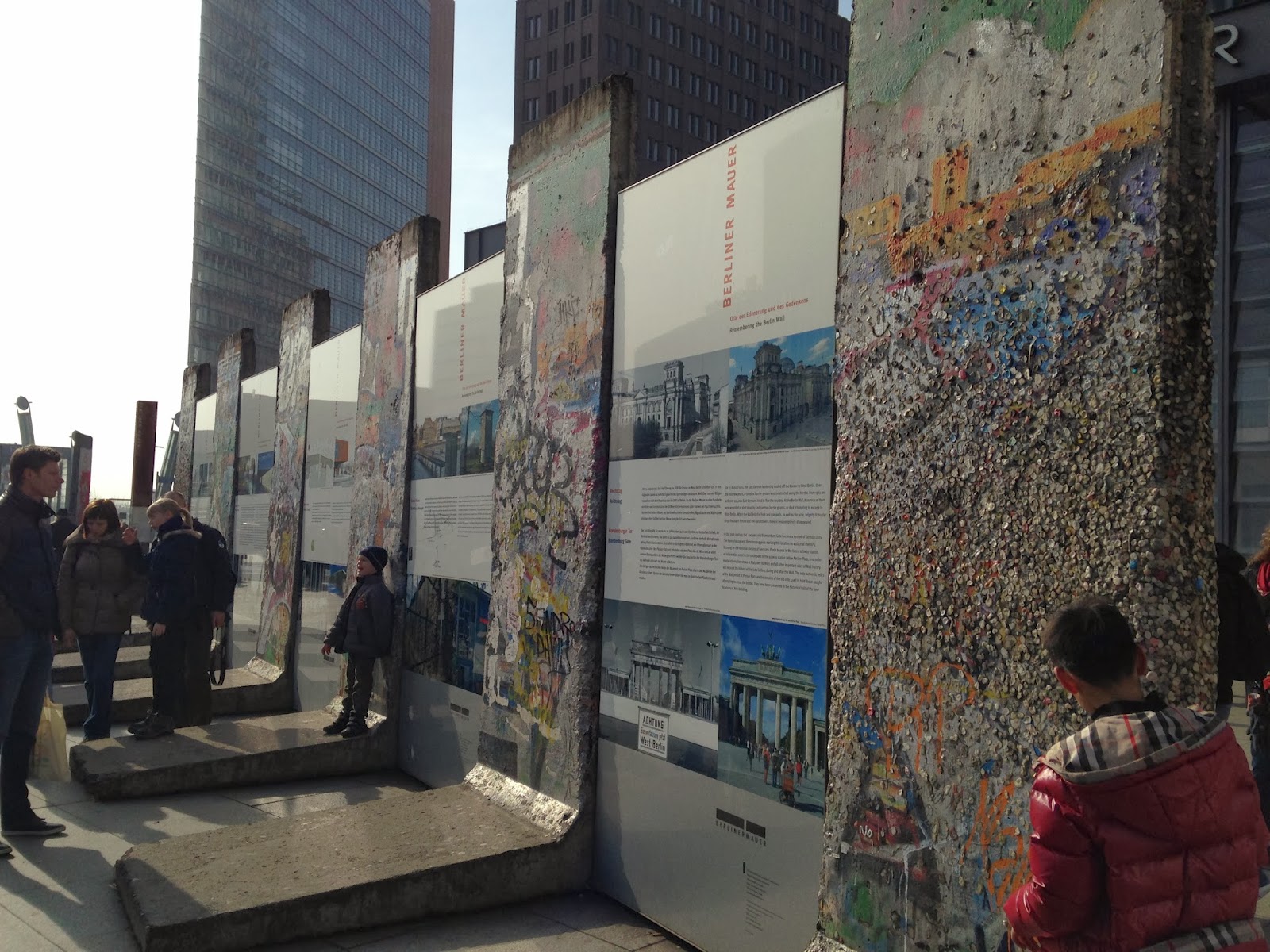
From the Holocaust memorial, we continued on to see sections of the Berlin Wall. Different locations within the city house these remnants, the majority of which are located at Checkpoint Charlie. 


While Checkpoint Charlie was interesting to see, it was very touristy. It was more enjoyable to see remnants of the wall next to everyday buildings, as in the above picture, then to see portions of the wall in a tourist area. However, I suppose that is to be expected and if you enjoy the history of the Cold War era then you should visit Checkpoint Charlie if you are in Berlin. 


The stop after Checkpoint Charlie, the Berlin Cathedral, proved to be my favorite location.  While a church has been located on this site since the 15th century, the current church, built in the Neo-Renaissance style, was inaugurated in 1905 by Kaiser Wilhelm. 


Even though the church is Protestant, in spite of being called a cathedral, it is a beautifully decorated church.  This church was recognized as the Supreme Parish Church and as such was the burial site for the Hohenzollern dynasty, the kings of Prussia and later the emperors of Germany. 


The admission ticket to the cathedral included access to the dome where there are spectacular views of historical Berlin, in spite of ongoing construction. From the dome, you can see a multitude of museums, the River Spree, the construction of the City Palace, and churches, among other buildings. 


The touring of the cathedral was our last major stop for the day and, as I mentioned, my favorite part. I found Berlin to be a wonderful city to visit which surprised me since I have never had any desire to visit. I would like to revisit the city because I know there was a lot that we didn't see and so I can visit Potsdam, the location of Prussian palaces, which borders Berlin to the southwest. Overall, Berlin is fascinating and from our brief tour, it seems as though it is a city that has something to offer to everyone. 


Tuesday, February 25, 2014

While we were in Prague, we visited two churches: St. George's Basilica and St. Vitus Cathedral. Both churches are situated within Prague Castle and St. George's is the earlier of the two churches. It was founded in 920 during the Romanesque period, which was an architectural style that was popular in the early Middle Ages, roughly the 6th century to the 10th century. 


Unfortunately, I was too close to to take a picture of the whole building, but I did my best to take a complete picture of the Romanesque portion of the building. 

The basilica houses the remains of the Přemyslid dynasty as well as shrines to Czech saints. One of those saints is Ludmila, whose remains are housed in a Gothic addition. Ludmila was an early duchess of Bohemia who, in the late 800's, was converted to Christianity. Once converted, Ludmila attempted to convert her subjects, a task in which she failed. 

However, she was highly influential upon her grandson Wenceslaus, who is mainly remembered in the Western world from the song "Good King Wenceslaus". Under the guidance of Ludmila, he became pious and helped further Christianity among the Czechs. As commonly occurs, her influence was resented, particularly by her daughter-in-law Drahomíra. To rid herself of Ludmila, Drahomíra contrived to have her mother-in-law murdered, which occurred in 921. After her murder, Ludmila was declared a saint by the Catholic Church.


I am not sure if I took a picture of her shrine, sadly enough, but some sites seem to indicate that the above area is where her shrine is located. I don't know if that is true, but this was one of my favorite pictures from the basilica so I figured I would share it. 

As you may have noticed, I did not know much about the history of the basilica before I went, so I didn't know what to look for while inside. The only thing I really knew during my tour was that the basilica once housed a convent. This convent was comprised of aristocratic women and their abbess was influential enough to crown medieval queen consorts. Other than that, I knew nothing of the basilica other than what I could infer, like that important people were buried there.

One thing I did notice, however, was the different architectural styles within the basilica. Thankfully, art history can generally be applied to buildings throughout Europe and it helped me identify some of the additional structures to the building. Within the basilica, there were quite a few structures that dated from the Baroque period, notably the staircase next to the alter and a chapel dedicated to another Czech saint.


Given the basilicas proximity to the political heart of Bohemia, these additions are not surprising. The additions, especially the shrines and chapels to saints, continued to honor Bohemia's past, which was to be expected in a church that sat within palace grounds. Furthermore, later generations seem to have added elements that they believed were needed. Of course, these are just my theories; there is really not much information about the basilica, let alone about why additional features were included to the original structure. 

Whatever the reasons were, the most interesting add-on is the basilicas facade:


As you see, this facade is not Romanesque. Instead, it dates from the Baroque period. While it is a beautiful facade, it is quite a contrast from the original Romanesque structure! 

The basilica is a fascinating structure and it was a pleasure to tour it. Personally, I need to re-tour it since I now know some of its history and I would highly recommend seeing it if you go to Prague. Of course, it has many aspects that I love rolled into one, so my recommendation is biased. But if you find yourself going to Prague, at least look into it as it is incredible to see in person!


Monday, February 24, 2014

The Czech Republic has not yet converted their currency to the euro, so Jon and I had to withdraw Czech crowns from an ATM when we arrived in Prague. The Czech Republic is supposed to eventually adopt the euro per their entry term agreements to the EU, but at this time no official date has been set. This is partially due to Czech opposition to the euro, but the Czech Republic also does not meet the economic criteria necessary to join the Eurozone. At any rate, when countries join the EU, they are not given specified deadlines as to when they must meet the criteria to join the Eurozone, so at this time the Czech Republic has not begun the conversion process. 


As you probably noticed, Czech money is not in single and double denominations like the dollar, the euro or the pound. Instead, their smallest bill begins at 100 crowns, which is about 5 dollars. Thank goodness for Jonathan because without him I wouldn't have been able to figure out how much I was spending. I kept telling him that it would have been very easy for me to spend a lot of money in Prague because I wasn't doing the math in my head to figure out how much something cost in either euros or dollars. 

Overall though, I think that we did alright. For anyone interested in going to Prague, we spent about 450 crowns ($22.56) on lunch, which included soup and a dessert for Jon and beer for myself. That really isn't too shabby for a major tourist town. And the portion sizes were decent:


I tried a Czech beer for lunch. I didn't like it as much as some of the beers that I have had here in Germany, but it was still good. 


This was my lunch. It was some type of omelette that was covered in cheese and stuffed with cheese and spinach. The spinach was a bit of an overkill, but it was pretty good. 


Jon tried the duck special. He absolutely loved it. They served it with some type of bread dumpling that was amazing. I think I ate half of his dumpling serving for him.. 

So as you can see, 450 crowns bought us a decent amount of food. Souvenirs seemed as if though they could add up after awhile, but we were also in the areas that had a lot of tourists. All in all, Prague seems to be an affordable city, at least when compared to other major European cities. Of course it has tourist traps and its expensive areas, but if you plan it right you don't have to spend a lot of money. They also had a lot of street vendors that had yummy looking food for inexpensive prices. 

And of course if you end up going to Prague, try a trdelnik. It's a doughy pastry that is covered in cinnamon, sugar, and  nuts and it is absolutely amazing. It is well worth breaking any diet you may be on!


Sunday, February 23, 2014

In high school, I used to watch the Travel Channel a lot and my favorite show was Passport to Europe. As the name of the show indicates, the hostess traveled all over Europe, but only one city she went to stayed with me and that was Prague. That city alone is the only place I remember her show talking about, probably because by that time I already had a list of cities in France and the United Kingdom that I wanted to go to and already knew about. However, that episode was my first introduction to Prague and it seemed so different than the cities, and countries, that I knew about, which is why I believed it stayed with me.


Having now experienced Prague myself, I can say that it is different than Western Europe in some aspects. However, being the capital city of the Czech Republic, formerly Bohemia, it has many similarities with other European cities. Also, the city obviously shares characteristics that other cities in the area have. Having visited these cities made Prague seem much more familiar than it may have otherwise.

Even though we were only in Prague for a day, I have a lot that I want to say about what we saw. As I research the places we went, I am learning  so many interesting things that I cannot condense into one blog post. Therefore, I have decided to do a series of blog posts so I can share everything that I discovered. I find it all to be intriguing, so I hope that you all will too!


Prague is the capital city of the Czech Republic and it is about 2 hours away from Dresden. 

The founding of Prague has been immortalized by a fanciful legend that dates back to the early medieval period. In this legend, a Slavic princess named Libuše had a prophecy as she overlooked the Vltava River.   Facing a forested area, she declared that she saw a great city whose glory would touch the stars. She proceeded to tell her people that they would find a man in this forested area where a steep cliff rises from the Vltava. He would be building a threshold, which is 'prah' in Czech, and she instructed her people to find him and build a castle named Praha there. Her dynasty, the Přemyslids, thus founded the city of Prague when they built Prague Castle on the cliff. 


During the Middle Ages, Prague, and Bohemia, was incorporated into the Holy Roman Empire. Being a constituent member of the Holy Roman Empire gave Bohemian rulers the privilege to vote for the Holy Roman Emperor. Before the title became exclusively Hapsburg, other dynastic houses held this title, including the Bohemian House of Luxembourg. This helped raise Prague's prestige within the Empire and helped Prague flourish. This trend continued throughout the Middle Ages, even when the city was not the capital of the Holy Roman Empire. 

During the Renaissance period, Bohemia's nobles chose to elect Ferdinand I, a Hapsburg married to a Bohemian princess, to be their king. This led to the Bohemian crown being a part of the Hapsburg Empire, which included the personal kingdoms of Austria and Hungary as well as the title of Holy Roman Emperor. Prague, at various times, was used as the capital city of this empire by some of the Hapsburg emperors, but following the Thirty Years War the capital of the empire was permanently based in Vienna.


Even so, Prague was still an important city within the empire and it was from Prague that Czech nationalism began to take root. As you may have noticed, the Hapsburg's ruled a multinational empire that was centered in Vienna. Vienna is culturally and ethnically German and as nationalism spread in the 19th century other areas of the empire resented being ruled by a German emperor and elite based in a German city. The Czechs were but one ethnic group that wanted greater autonomy from Vienna at this time, which they were not given. The only country that was successful in gaining greater autonomy was Hungary, which changed the name of the Austrian Empire to the Austro-Hungarian Empire. In this agreement, Hungary kept Franz Joseph as their king, but they were no longer part of or subject to the Austrian Empire. Thus, they were a sovereign nation that shared their monarch with the Austrian Empire. This meant that areas like foreign policy mirrored Austria's policies, but otherwise they controlled their government. 


The creation of this Dual Monarchy attempted to relieve Franz Joseph's difficulties in ruling a multinational empire; however, these tensions were exacerbated as other minorities within the empire, such as the Czechs, wanted to receive the same autonomy that Hungary received. Franz Joseph did nothing to relieve these tensions, which prompted his heir, Franz Ferdinand, to think about he would solve this problem once he became emperor. 


Had he become emperor, Franz Ferdinand's solution would have been to allow greater autonomy to all the ethnic groups within the Austrian Empire and he may have wanted to create a Triple Monarchy that included Bohemia as well as Austria and Hungary. He believed that giving greater autonomy to these ethnic groups would relive the tensions that nationalism had wrought on the empire. Whether or not his views were correct (greater autonomy could have either led to the desire for more autonomy which would have eventually broken up the empire or he could have successfully engineered a way to save the empire in spite of nationalism), Franz Ferdinand never enacted them because in 1914 he and his wife were assassinated, which sparked World War I.  

 Austria-Hungary was dissolved following World War I. This dissolution came about both internally, as national groups took advantage of Austria's weak position, and externally, with people like Woodrow Wilson denouncing multinational empires. Thus, with the backing of the United States, the empire was dissolved and ethnic groups that had previously been a part of the empire were free to create their own states.  This backing was, in part, derived from the fact that Czechoslovakia  had supported the Allies during the war thus fighting against their government. 


The new state of Czechoslovakia choose Prague to be its capital, which propelled the city to become, once again, a capital city. This new country was still multicultural as it was the home of ethnic Czechs, Slovaks, and Germans. Even though Czech domination created tensions between the Slovaks, Germans, and Czechs, Czechoslovakia was the only country in this area that maintained a democracy until it was subsumed by Germany in the Second World War. 

During World War II, Hitler, in his quest to eradicate nationalities, attempted to either assimilate or exterminate the native Czech population since the Czechs are a Slavic ethnic group, which was one of the 'lesser' nationalities according to Hitler. To this end, Czechs, especially the Czech intelligentsia, were sent to concentration camps, deported, or violently repressed in order to make the area more German. This ended in May of 1945, when citizens of Prague, with the help of the Russians, were successful in overthrowing the German government that operated from Prague. 

Czechoslovakia was reformed following the war and came under the the political influence of the USSR. The Czechs, who felt betrayed by the West in the lead up to World War II, were grateful to the Soviets for liberating their country. Therefore, Czechoslovakia, and Prague, fell under the Iron Curtain and although there were attempts to break free from Communist influence, notably the Prague Spring, Czechoslovakia remained Communist until 1989.

   
In 1989, Czechoslovakia underwent the Velvet Revolution which returned Czechoslovakia to a democracy. Four years later, the country underwent another political change when it split into two countries. The tensions between the Czechs and the Slovaks did not dissipate during the Communist regime and in 1993 the Czech Republic and Slovakia peacefully, in contrast to Yugoslavia, devolved into two separate countries. Prague thus became the capital of the Czech Republic and today is a popular tourist destination. Even in February, the city had a lot of tourists walking around, and Dr. Gommlich says that in the summer months the city is hard to navigate due to all the tourists. 


Even with all the people, I still really enjoyed visiting Prague. As the most important city in Bohemia, it is home to beautiful sites and has a rich history, both culturally and politically. Over the next few days, I will expand upon my visit to Prague because there is no way I could do the city justice in just one post (even if I was only there for one day!). I look forward to visiting the city again, and hopefully I will be able to visit other areas of Bohemia as well. 


Friday, February 14, 2014

Sorry for the lapse between posts. Writing a post can be time consuming and I have been pretty busy with school work and other activities lately. Classes are going well though, or at least I think that they are! I guess that will be determined by my grade... 

At any rate, even with our schoolwork and observations, we still go on excursions over the weekends that are organized by Dr. Gommlich. He, so far, has taken as around the State of Saxony which is the area he has lived in for most his life except for the time he spent in Kent. Since he grew up here he knows so much about this area which  makes travelling with him wonderful. And it's awesome that he takes the time to travel with us on the weekends. He doesn't have to do it, but he chooses to and for that I am very grateful.

Last weekend, we traveled to two different towns in Saxony: Görlitz and Bautzen. Görlitz and Bautzen historically belong to a region known as Lusatia which was named after a Slavic tribe that first settled this area. In the 10th century, the Margraviate of  Meißen began to move into the area so areas of land were absorbed into the Margraviate. However, over the next few centuries political ownership of Lusatia changed frequently and at various times this region was under the control of Poland, then the Margraviate of Meißen again, and then finally to Bohemia in the late 12th century. This area remained under Bohemian influence until the 15th century when Lusatia opposed Bohemia in the Hussite Wars.* The Hussite Wars weakened Bohemia's power over Lusatia and for most of the 15th century the area gave homage to Hungary. However, by the beginning of the 16th century they were once again in the political sphere of Bohemia which is where it stayed until the end of the Thirty Years War.


A tower that still remains from the medieval city walls of Görlitz

At the end of the Thirty Years War, Lusatia, and thus Görlitz and Bautzen, were transferred to the Duchy of Saxony (later the Kingdom of Saxony) which is where Jon and I currently live. Only now this area is known as the Federal State of Saxony. While both these areas are today part of the State of Saxony, areas of Lusatia continued to change hands with Görlitz and other areas becoming part of Prussia in the 19th century. Görlitz, and other areas within Lusatia, remained part of Prussia until the end of World War II. Even after the War, the political boundaries of this area continued to shift. 

Before the end of World War II, German political boundaries were different. 


The light blue area on the map was all the territory that belonged to the German Reich as of 1939 (which included Austria and Czechoslovakia). At the end of World War II, Polish borders were moved west as they absorbed territory that was formerly German and lost some Eastern territory to the Russians. The new German-Polish boundary was formed along what is is known as the Oder-Neisse line which are rivers in Central Europe. As a result, Germany lost the following territories: most of Silesia, over half of Pomerania, the eastern portion of Brandenburg, some of Saxony, Danzig, and East Prussia (the warm port of Königsberg went to the USSR). All of these areas had large, native German populations living in them and most of the areas had been historically under German influence since the Late Middle Ages.


This map shows both the Occupation Zones following World War II and the whitish areas show the areas that Germany lost to Poland and to the USSR. As you can imagine, these areas were heavily populated by Germans during World War II and after the war all ethnic Germans and German nationals were forcibly expelled from these areas, as they were from other countries in Europe. Even Germans, ethnic or nationals, who had not been affiliated with or supported the Nazi Party were expelled. These expulsions were often riddled with violence and conditions once the expellees entered Germany were not the best since Germany was devastated, economically and politically, following the war. While the expellees were granted German citizenship, life was not any easier for them once they reached post-war Germany.

Lusatia was also affected by these post-war boundary changes. Portions of this area become Polish, and Görlitz was split into two cities. Görlitz sits on the Neisse river, which was the new boundary line that was agreed upon by the Allies and Poland. As a result, this German town, which was an important city in Lusatia, became two separate towns: Görlitz and Zgorzelec. These were the towns that we visited first on Saturday.


This is a view of the cathedral that sits right next to the Neisse in Görlitz.

Görlitz became an important city to Lusatia during the Middle Ages because it was situated on the Via Regia which were royal highways that connected Europe.


I, for some reason, did not take a picture of Görlitz's position on the Via Regia in this picture, but to the very right of the picture you can see Dresden (which is not on the road). To the right of Dresden lies Görlitz. As you can see from the picture, this road connected central Europe to France and to the modern day Netherlands. Lying on this road benefited towns and Görlitz was one of these towns. 
Since Görlitz was an important town, it was important to the political spheres that it belonged to throughout its history. As result, Görlitz has a variety of architecture styles that you can still see. Görlitz was not damaged during World War II so many of their buildings from the Gothic, Renaissance, Baroque, and Art Nouveau eras still stand and they still show features of the architect of the countries that they were affiliated with at the time. 


The fact that the city remains so much of its pre-war character attracts film makers. Parts of Inglorious Bastards and The Reader were filmed here and more recently The Grand Budapest Hotel was filmed here. If you want to check the last movie out, it is an English language movie and it was filmed in this building:


The building is very large and would not fit into my picture since I was too close. Dr. Gommlich says that the inside of the building is beautiful, but we could not go inside so I will not be able to see it until I watch The Grand Budapest Hotel

After leaving Görlitz, we traveled to Bautzen which is also historically part of Lusatia. It is often referred to as the historic capital of Lusatia and is a cultural center of the Sorbs who are a minority Slavic group who live in this area of Germany. 


Since it is the cultural capital of the Sorbs, both Sorbian and German are used in Bautzen. The right side up word of Bautzen is in Sorbian. As this area is part of Lusatia, Bautzen has changed political boundaries throughout history as well. However, I felt that their architecture was more unified than the architecture that we saw in Görlitz.


Like Görlitz, Bautzen was not bombed during the war so portions of their medieval structures, like this tower from the old city wall, still stand. 


This picture shows a portion of an old castle that was built in Bautzen. Bautzen was amazing to see and after we were done touring the sights, we stopped for drinks at a German restaurant before we caught our train. 


 Following the excursion, Jon and I went out with some of the other students in the program to the Neustadt. One of the girls in the program had seen a molecular bar the night before so were looking to have a drink there because it sound interesting. We didn't quite know where it was so it took us a little while to find the bar, but it was a fun bar so I am glad that we didn't give up and go to another bar! Here are they types of drinks that they serve there:


Like I said, they were very interesting!

 If you are all interested in my posts, I will try to be more regular so you can all see what Jon and I are doing here. At any rate, I hope that everyone at home is doing well and we miss you all!


*The Hussites followed the teachings of the reformer Jan Hus (1369-1415). He was an early reformer of the Church  were considered by the Catholic Church to be a heretic as were his followers. Crusades were fought against the Hussites and Lusatia allied with the Holy Roman Emperor against Czech Hussites (some of whom were influential within the Bohemian government).